
West Berkshire grits 529.5km of main roads from 2 November, with 1,200 tonnes of salt. Side roads wait for 72 hours of frost, and pavements have no budget.
West Berkshire’s gritters go on standby from Monday 2 November. The council’s winter season runs to Sunday 4 April 2027, and can be extended if the weather demands it.
The 2026/27 Highway Winter Service Plan was approved on Friday 23 October by Councillor Stuart Gourley, the executive member for environment and highways. The decision sheet says it can still be called in until 5pm on 30 October.
The report behind it sets out what gets treated, and what does not. No routes have been added or removed on any network this year.
Which roads are salted, and when
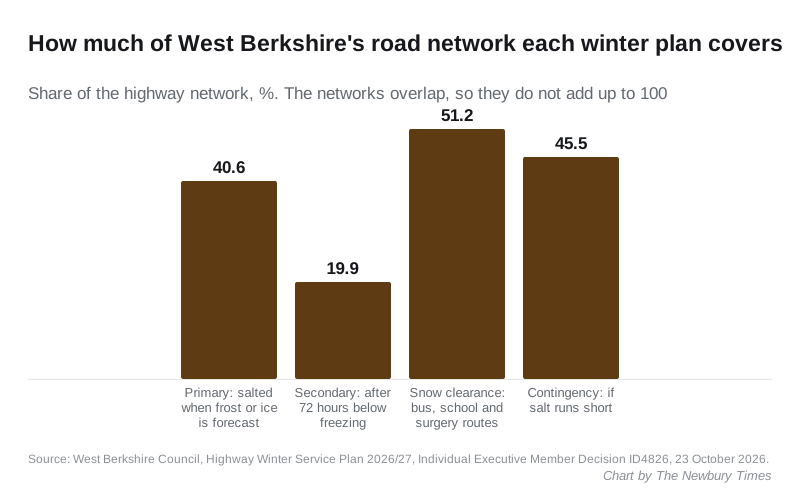
The council runs four overlapping networks:
- Primary network, 40.6% of roads. Salted whenever hoar frost or ice is forecast. It covers every A and B road, plus some important C and unclassified roads. That is 529.5km of carriageway, with budget for up to 50 runs.
- Secondary network, 19.9% of roads. Treated only after road surfaces have stayed below freezing for an unbroken 72 hours, three days and nights.
- Snow clearance network, 51.2% of roads. In snow, bus routes and the roads to schools and doctors’ surgeries are cleared as a priority.
- Contingency network, 45.5% of roads. Used instead of the others only if salt runs short nationally or the government orders councils to ration it.
The report is plain about money. The revenue budget covers the primary network and the council’s own salt bins. “There is no budget provision for treatment of the secondary network, snow clearance network or footway networks.”
Pavements are cleared of snow “using cross-service resources as they become available”. The priority footways are town and village centres, and paths to hospitals, surgeries, schools and council buildings.
Salt and last winter
Last winter the primary network was salted on 34 occasions. The snow network was treated once, and the secondary network not at all. About 1,584 tonnes of salt went on the roads.
This season starts with 1,200 tonnes at the Chieveley depot. The stock is topped up through the winter and must not fall below 500 tonnes.
Of 305 gritting routes run last winter, 304 were finished inside the three-hour target, the report says.
Two other changes are worth knowing:
- this winter’s gritting will be delivered by the council’s highways term contractor, Marlborough Highways Ltd; the report credits last winter’s runs to Volker Highways
- a £225,000 grant, awarded towards the end of last winter, is paying for thermal sensors on roads and gritters, so the council can later salt route by route rather than area by area
Salt bins
There are 476 salt bins across the district. Only 30 belong to West Berkshire Council. The other 446 are owned and refilled by town and parish councils.
What it means for you
If you live on a side street: do not expect a gritter after the first frost. Most residential roads are not on the primary network, and the secondary network waits for three days of continuous freezing. Plan for that if you drive early.
To check your road: the council’s gritting page links to its primary route list and an online map of salt bins.
If a salt bin is empty or missing: most belong to your town or parish council, so start there. Report council-owned bins and ice problems through the council’s report form.
On pavements: there is no budget for footway gritting. Snow is cleared from priority footways when staff are free from other work.
Have your say