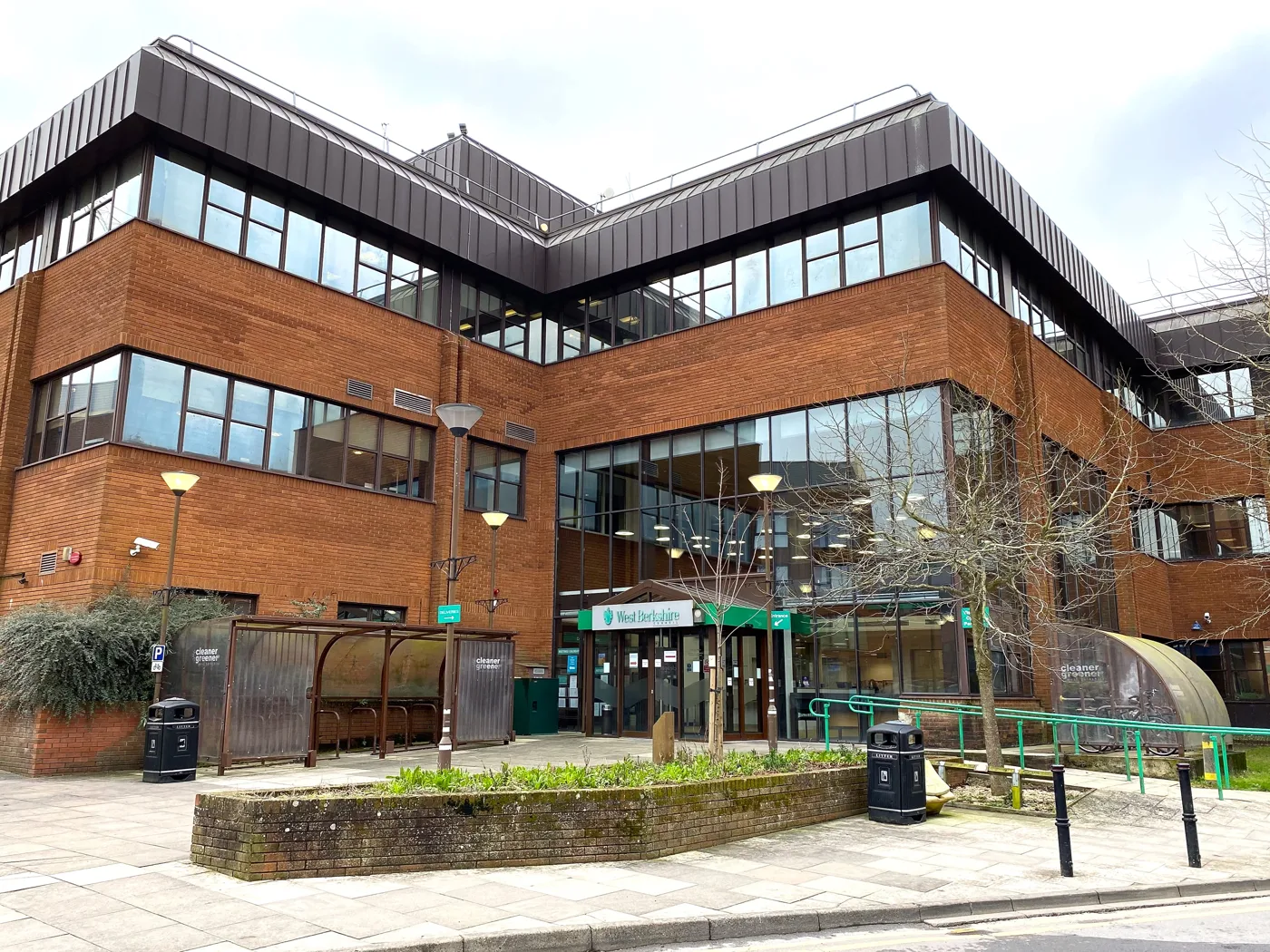

Counsel says a permanent exemption is the least defensible option. Councillors decide the future of 35 pre-2001 Newbury taxi plates on Monday afternoon.
Councillors decide on Monday afternoon whether to start closing a Newbury taxi exemption that has run since 2002.
Thirty-five hackney carriage licences in the town are allowed to be ordinary saloon cars rather than wheelchair accessible vehicles. Every other Newbury hackney carriage has had to be wheelchair accessible for twenty-four years. West Berkshire Council’s Licensing Committee meets at 4.30pm on Monday 7 September in the Council Chamber at the council offices in Market Street to decide what happens to those 35.
The committee has four options in front of it, the results of a seven-week public consultation, and independent advice from a barrister that the option of leaving things alone is the weakest of the four in law. (West Berkshire Council, Licensing Committee, 7 September 2026)
What a protected plate is
Before 2002 the council capped the number of hackney carriage licences it would issue in the “Town Zone”, the area of the former Borough of Newbury. The rest of the district, the “District Zone”, had no cap.
In 2002 the council lifted the Newbury cap. In exchange it attached a condition: every new Town Zone licence would have to be a wheelchair accessible vehicle. Anyone who already held a licence issued before 1 April 2001 was allowed to carry on running a saloon car for as long as they remained the licence holder. Those licences became known as protected plates.
In April 2005 the committee went further and agreed the “family exemption”, letting a protected plate pass to a member of the proprietor’s immediate family without losing the saloon car protection. The policy defines immediate family narrowly, and the burden of proving the relationship falls on the licence holder. It covers a:
- mother or father
- spouse or partner
- child
- brother or sister
- step-mother or step-father
- step-child
- step-brother or step-sister
No other relative qualifies. (West Berkshire Council, protected plates consultation)
A discrepancy in Monday’s papers
The council’s consultation page and the published outcome report both say there are 35 protected plates left. The consultation document reprinted as Appendix A in Monday’s agenda pack says 29, in the same sentence, in the same words. The council has not reconciled the two figures anywhere in the pack. We have used 35, the figure the council currently publishes and the one its outcome report repeats. (Appendix A, consultation document)
The four options, and what people said
The consultation ran from 27 March to 15 May 2026. It drew 38 responses: 37 online and one emailed in.
| Option | Support | Oppose |
|---|---|---|
| 1. Exemption ends when a licence is transferred, from 1 January 2027 | 56.7% | 40.0% |
| 2. Exemption ends when a licence is renewed, from 1 January 2029 | 46.7% | 50.0% |
| 3. Keep the exemption but stop family transfers | 16.7% | 76.7% |
| 4. Keep everything as it is | 20.0% | 76.7% |
Option 1 drew the most support. Both options that would keep the exemption were opposed by more than three quarters of respondents.
Opposition to option 3 came from two directions at once. Some respondents wanted stronger action on accessibility. Others were proprietors worried about family succession and about what a protected plate is worth.
Those who backed change cited accessibility, equality and a fairer licensing regime. Those against pointed to the value of a mixed fleet, passenger preference for saloon cars, and the money involved for existing holders.
Who actually responded
The respondents were not a cross-section of the town. Of the 38:
- 12 were taxi proprietors
- 8 were drivers
- 1 was both a proprietor and a driver
- 16 were members of the public
- 1 was a taxi user
Two thirds identified as male, and 96% of those who answered the question said they lived in West Berkshire. Only one respondent said they held a protected plate, so the group with most to lose barely spoke for itself in the numbers, even though proprietors and drivers together made up 21 of the 38.
Twenty-five people said they already knew about the exemption. Eleven did not.
What the barrister told the council
The council instructed independent counsel specialising in licensing and local government law before the consultation opened. The report sets out the advice received:
- The original reason for exempting pre-2001 vehicles was understandable when it was introduced, but more than twenty years have passed and the justification for a permanent exemption “has weakened significantly”.
- Protected plate holders are treated differently from every other proprietor, because they alone are exempt from the accessibility requirement.
- Transferability is the particular problem. Transitional protection for existing holders may be justifiable, but extending it to family members or successors creates distinctions that “may become increasingly difficult to objectively justify”.
- The most legally robust approaches are removing the exemption on transfer after a set date, or removing it after a reasonable transitional period.
- Keeping the exemption indefinitely is “the least legally defensible option”.
Counsel also advised that there is no significant risk of a successful legal challenge to removal, provided members genuinely weigh the consultation responses, accessibility needs and equality impacts. The greater legal risk, counsel said, would come from giving too little regard to disabled passengers.
Officers have added a fifth possibility of their own. Existing holders could keep the exemption for as long as they own the licence, with it ending on any transfer to a third party. That would leave every current proprietor untouched and let the scheme die out over time.
The argument the other way
The report does not pretend the change is free. Wheelchair accessible vehicles cost more to buy than saloon cars, and more to finance, insure, maintain, repair and service. Drivers need training. Proprietors told the council that a protected plate carries a commercial value precisely because it comes with the flexibility of a saloon.
The council’s answer is blunt: a hackney carriage licence does not create a permanent property right, and a licensing authority may change its requirements to promote safety, accessibility and equality.
The consultation also collected an argument that cuts against wheelchair accessible vehicles. Some residents, particularly older ones with mobility problems, find them harder to get into than a saloon car. Other comments went the other way, calling the plates discriminatory against wheelchair users and saying they restrict fair competition in the trade.
The report warns that where an accessible vehicle is not available, passengers can face longer waits, greater dependence on carers, missed medical appointments and reduced access to work and education.
What it means for you
If you use a Newbury taxi from a rank or flag one down, nothing changes this week whatever the committee decides. None of the four options takes effect before 1 January 2027, and the two that would keep the exemption change nothing at all.
If you use a wheelchair, the practical question is how quickly the remaining saloon-car plates leave the fleet. Under option 1 a plate loses its exemption only when it changes hands, so the pace depends entirely on how often these 35 licences are sold or passed on. Under option 2 every one of them would have to be a wheelchair accessible vehicle by the first renewal after 1 January 2029.
If you hold one of the 35, option 1 leaves you alone for as long as you keep the licence, and so does the officers’ fifth suggestion. Option 2 would give you until 2029. The report accepts you may face real costs and says a hackney carriage licence is not a permanent property right.
The meeting is at the council offices in Market Street, a few minutes’ walk from the Wharf. If you are driving in, our guide to parking in Newbury sets out which car parks are actually empty at 4.30pm on a Monday, and the roadworks and travel page has this week’s closures.
There is no follow-up date in the papers. The review was promised within six months of the policy being adopted in December 2025, and officers say that promise has now been kept, so whatever the committee decides on Monday is likely to stand until the policy’s next annual review.
Sources
- West Berkshire Council, Licensing Committee, Monday 7 September 2026 for the meeting date, time, venue and agenda.
- Cover report, Outcome of the Consultation on the Protected Hackney Carriage Plate Arrangements, by Mark Groves, Licensing Operations Manager, for the four options, counsel’s advice, the consultation percentages, the make-up of the respondents, the financial implications and the officers’ fifth suggestion.
- Appendix A, the consultation document for the history of the Town Zone cap, the 1 April 2001 cut-off, the 2005 family exemption and its definition of immediate family, and for the figure of 29 plates.
- Appendix B, Outcome of the consultation for the figure of 35 plates, the consultation dates and promotion, the response counts and the awareness question.
- Appendix C, Equality Impact Assessment for the equality analysis and the preferred course of action.
- West Berkshire Council, protected plates consultation page for the published figure of 35 and the four options as put to the public.
Checked on 6 September 2026. Percentages are as printed in the council’s report and exclude neutral and “not sure” answers, so they do not always total 100.
Have your say