

From 31 October, ten objections no longer send a West Berkshire planning application to councillors. What changes, and the 11 cases on the last old-style agenda.
From 31 October, ten letters of objection will no longer be enough to send a West Berkshire planning application to a committee of councillors. Full council agreed the new arrangements on Thursday 15 October, the council said the next morning.
The district’s three planning committees will be replaced by one Planning Committee of 11 councillors, normally meeting monthly. The change follows new national rules that send most planning decisions to officers.
The last meetings under the old rules take place on Wednesday. The Western Area Planning Committee has 11 applications on two agendas on 21 October. Ten of them cite the number of objections as a reason they are in front of councillors. Six are there on that ground alone.
What changes on 31 October
The council has no choice about the new system. The officer report to council says the Town and Country Planning (Discharge of Local Planning Authority Functions) (England) Regulations 2026 come into force that day. They were made on 15 July. The council could choose only some local details.
Until now, the council’s scheme of delegation sent an application to committee in several situations, including when:
- it was recommended for approval and had at least 10 letters of objection
- it was recommended for approval and a petition of objection had at least 20 signatures
- a councillor called it in within 30 days of it appearing on the weekly list
From 31 October:
- some types must always be decided by officers. These include householder applications, schemes of one to nine homes on sites under half a hectare, discharge of conditions and non-material amendments
- other applications can go to councillors only if they pass a “gateway test”. They must raise a significant planning matter, or an economic, social or environmental issue of significance to the local area
- a nominated councillor and a nominated officer must both agree to refer an application. If they do not, officers decide it
- the number of objections will not, on its own, trigger a referral
The report explains why on that last point. A referral has to be made for planning reasons, it says, and promising a committee to every application with “(for example) 10+ objections” would raise public expectations.
What stays the same
The council says the change is to how decisions are made, not the policies used to make them. Under the report:
- anyone can still comment on any application, and material planning points are still taken into account
- a ward councillor can flag any application in their ward, or a neighbouring ward, within four weeks of it being validated
- every major application is automatically looked at for possible referral
- applications by the council, on council land, by councillors or by planning staff can still go to committee without passing the gateway test
- speaking rights at committee are unchanged for parish and town councils, objectors, supporters, applicants and ward councillors
Each officer report will now say whether the application was considered for referral, and why it was or was not sent to committee. The council has agreed to review the arrangements six to 12 months after they start.
Fewer meetings, and many cancelled
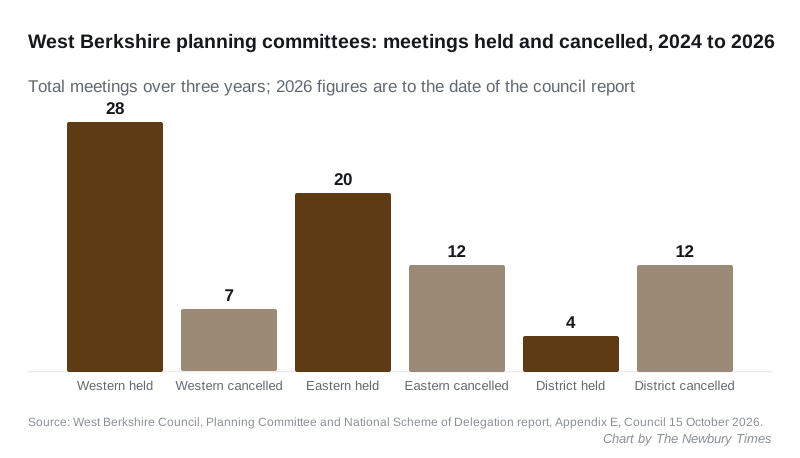
The council’s case for a single committee rests on its own figures. They are in Appendix E of the report, covering 2024 to the date of the report in 2026.
| Committee | Meetings held | Meetings cancelled | Items considered |
|---|---|---|---|
| Western Area | 28 | 7 | 71 |
| Eastern Area | 20 | 12 | 36 |
| District | 4 | 12 | 4 |
| Total | 52 | 31 | 111 |
The District Planning Committee has held no meetings at all in 2026, with four cancelled. About 30 of the applications decided at committee over the period would have gone straight to officers under the new rules, the appendix says.
Councillors usually back their officers. Between 2019 and 2026, 142 of 168 Western Area applications (85%) and 83 of 108 Eastern Area applications (77%) were decided in line with the officer’s recommendation.
Officers accept that one district-wide committee “risks reducing local knowledge or representation”. They argue that 11 members is enough to keep it. The legal maximum is 13.
The last Western Area meetings: 21 October
Both meetings are in the Council Chamber at the Council Offices, Market Street, Newbury. Councillors visited the sites on 15 October. Morning agenda (9.30am) and afternoon agenda (4.30pm).
| Application | Where | Proposal | Why it is at committee | Officers recommend |
|---|---|---|---|---|
| 23/02596/FULMAJ | Longcopse Farm, Vanners Lane, Enborne | Up to 24 travelling showpeople’s plots | More than 10 objections | Approve |
| 26/00243/OUTMAJ | Land south of Tower Works, Lambourn Woodlands | Changes to an approved logistics warehouse for Walker Logistics, with an aircraft museum building | Called in by the Development Manager; more than 10 objections | Approve |
| 26/00244/RESMAJ | Same site | Reserved matters for the same scheme | As above | Approve |
| 25/00599/FULMAJ | Land west of High Street, East Ilsley | 14 homes, open space and shared office space (“Pen Meadow”) | More than 10 objections | Approve, subject to a section 106 agreement |
| 26/00036/MDOPO | Spring Meadows, Great Shefford | Change to a 1988 legal agreement | More than 10 objections | Approve |
| 26/00042/FULMAJ | 54A Kiln Road, Newbury | Offices demolished for a three-storey, 87-bedroom care home | More than 10 objections and a ward councillor call-in | Approve, subject to a section 106 agreement |
| 26/00403/FUL | Elcot Park Hotel, Elcot | Padel court already built, for 24 months | Ward councillor call-in | Refuse |
| 26/00055/FUL | 100 High Street, Hungerford | One new home | More than 10 objections | Approve |
| 26/01165/LBC | 100 High Street, Hungerford | Widening an archway in a listed building | More than 10 objections and a call-in | Approve |
| 25/01770/HOUSE | 8 Speen Lane, Newbury | Two-storey side and single-storey rear extension | More than 10 objections | Approve |
| 26/01179/HOUSE | Collaroy Road, Cold Ash | Bi-fold doors and decking at the rear of a house | More than 10 objections | Approve |
The last two are householder applications. From 31 October, applications of that type must always be decided by officers, however many objections they draw.
Two items have drawn the most opposition. At Enborne, 90 people wrote in, all objecting, the officer report says. Enborne Parish Council objects too. The site is allocated for 24 showpeople’s plots in the Local Plan Review adopted in June 2025. The report says the parish council’s High Court challenge to that allocation was refused permission in January 2026.
At Kiln Road, 32 people objected and none supported, according to the report. Newbury Town Council also objects, citing overdevelopment, amenity, the soakaways and the River Lambourn. Parking on Kiln Road and Northwood Drive is the most common concern in the letters.
What it means for you
If you object to an application after 31 October: your letter still counts if it raises a planning point, such as traffic, overlooking, flooding or the Local Plan. It will no longer send the application to councillors by weight of numbers. Write to the planning point, not just to register opposition.
If you want councillors to decide a case: ask your ward councillor to flag it. They have four weeks from the date the application is validated, and the nominated councillor and officer must then agree it passes the gateway test.
If you want to speak on Wednesday: contact Democratic Services through the agenda pages above. The committee’s speaking rules are set out on each agenda.
If you have applied for an extension or minor works: from 31 October, a householder application will be decided by a planning officer.
You can follow new applications on our planning news page.
Sources
- West Berkshire Council: New planning arrangements for West Berkshire from 31 October, 16 October 2026
- Council, 15 October 2026: agenda and papers, item 10 and Appendix E
- West Berkshire Council: planning decisions and delegated powers, read 18 October 2026
- Western Area Planning Committee, 21 October 2026: 9.30am and 4.30pm agendas and officer reports
Have your say