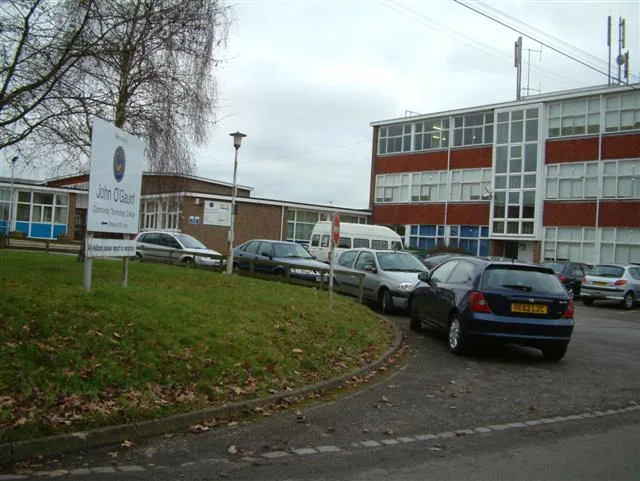

West Berkshire's Executive approved £4.45m on 12 November for a 25-place autism base at the rebuilt John O'Gaunt School in Hungerford. Completion is expected in 2029/30.
West Berkshire Council is being asked to put £4.45m into a new base for pupils with complex autism at John O’Gaunt School in Hungerford. It would have 25 places and be built as part of the Department for Education’s rebuild of the school.
Updated 20 November: the rebuild is now being planned at the larger size. In a written answer published on 19 November, the council said the DfE has agreed to rescope John O’Gaunt’s feasibility study to four forms of entry (120 places a year), because Hampshire is proceeding with the proposed closure of The Clere School. The final size is not confirmed. The Executive decision had no call-ins registered on the afternoon of 20 November, the last day for one. Updated 13 November: the Executive approved both recommendations on 12 November, the capital funding and the temporary use of the council’s retained land at the school for decant classrooms. The decision record says it can be called in until 5pm on 20 November and takes effect on 21 November if it is not.
The council’s Executive decided on Thursday 12 November. The officer report says the money has to be promised now. The DfE wants the council’s commitment before its own decision meeting on the rebuild later this month.
The school is being rebuilt, but smaller
John O’Gaunt was accepted into the DfE’s School Rebuilding Programme, which replaces school buildings in the poorest condition in England. The report says the DfE has finished its surveys and will recommend a full rebuild.
That rebuild is planned around a smaller intake. The report says it is “based on a 3FE intake (90 pupils) as against their current Published Admission Number” of 120. So the new school would be designed for three forms of entry a year rather than four.
The sports hall has changed too. The DfE first said the rebuilt school would have no sports hall because of its size, only the equivalent of two activity studios. It now says its current option is a three-court sports hall and one studio. The report says the effect on community use and the leisure contract will be covered in a separate report.
What the autism base would be
The base would be a “Specialist Inclusion Base” for pupils with complex autism in Years 7 to 11. The business case describes:
- dedicated teaching, intervention and sensory spaces
- staff rooms and meeting areas
- hygiene facilities
- its own outdoor space
Pupils would get specialist support while still taking part in mainstream lessons and school life “where appropriate”. It would open with a Year 7 cohort and grow each year. The report expects five pupils to join annually.
The council says there are too few local secondary places for pupils with complex autism. When local schools cannot meet a child’s needs, it pays for independent or non-maintained special schools, or for teaching outside school. The report puts an independent place at more than £70,000 per pupil a year.
The cost and who pays
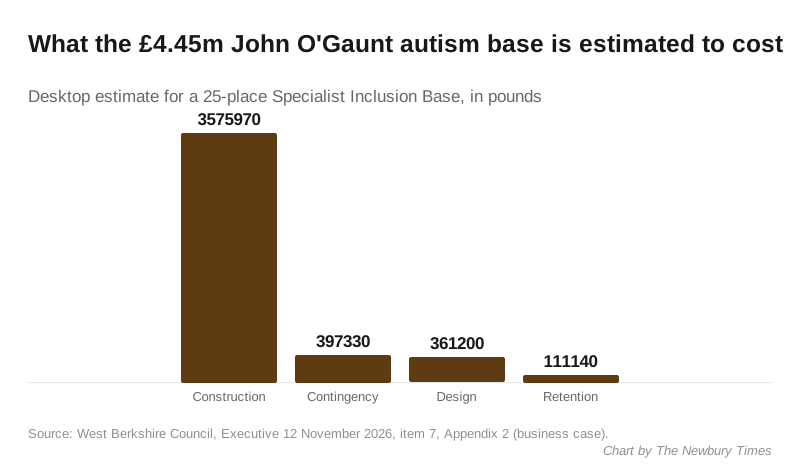
The business case estimates the base at £4,445,640. That breaks down as:
| Item | Estimate |
|---|---|
| Construction | £3,575,970 |
| Project contingency | £397,330 |
| Design | £361,200 |
| Retention | £111,140 |
| Total | £4,445,640 |
The report says this is a “desk top” estimate and the final figure may change. The council and the DfE have not yet agreed how costs will be split between the rebuild and the autism base.
Funding would come from £3.75m of existing external grant and £700,000 from the Community Infrastructure Levy, the charge paid by developers. If the levy pot runs short, the report says the gap would be covered by extra borrowing.
The business case forecasts about £626,400 of savings in the first five years, from fewer out-of-area placements. It notes that school transport savings have not been counted.
The timetable runs past West Berkshire Council itself
The report sets out this timetable:
- November 2026: DfE decision on the rebuild’s scope and funding
- December 2026 to March 2027: outline design to confirm the project works
- April 2027: a design and build contractor appointed
- 2029/30 financial year: completion, most likely
The DfE will ask for the council’s money at completion. That falls after 1 April 2029, the date West Berkshire Council is due to be replaced by the new Ridgeway Council. The report says the funding commitment and project governance will have to be dealt with in that handover.
Several things are still unresolved, the report says. They include the legal mechanism for paying the DfE, how the council protects its money in a DfE-run project, and a licence for the DfE to put temporary classrooms on the council’s “retained land” at the school during the works. The Executive is also asked to approve that temporary use.
What it means for you
If you have a child with complex autism in the Hungerford area, this base would offer specialist secondary places at the town’s own school rather than further afield. It would not open for several years, and the first intake would be small: five pupils a year.
The base is a “significant change” to an academy. Under DfE rules that means at least three weeks of public consultation before it can go ahead. The report says the council is talking to the school’s trust about running it. We will add the dates when they are published.
Families of current pupils should expect building work and temporary accommodation on the site at some point after 2027. No dates for that have been published.
The agenda and papers for the 12 November meeting are on the council’s website.
Have your say