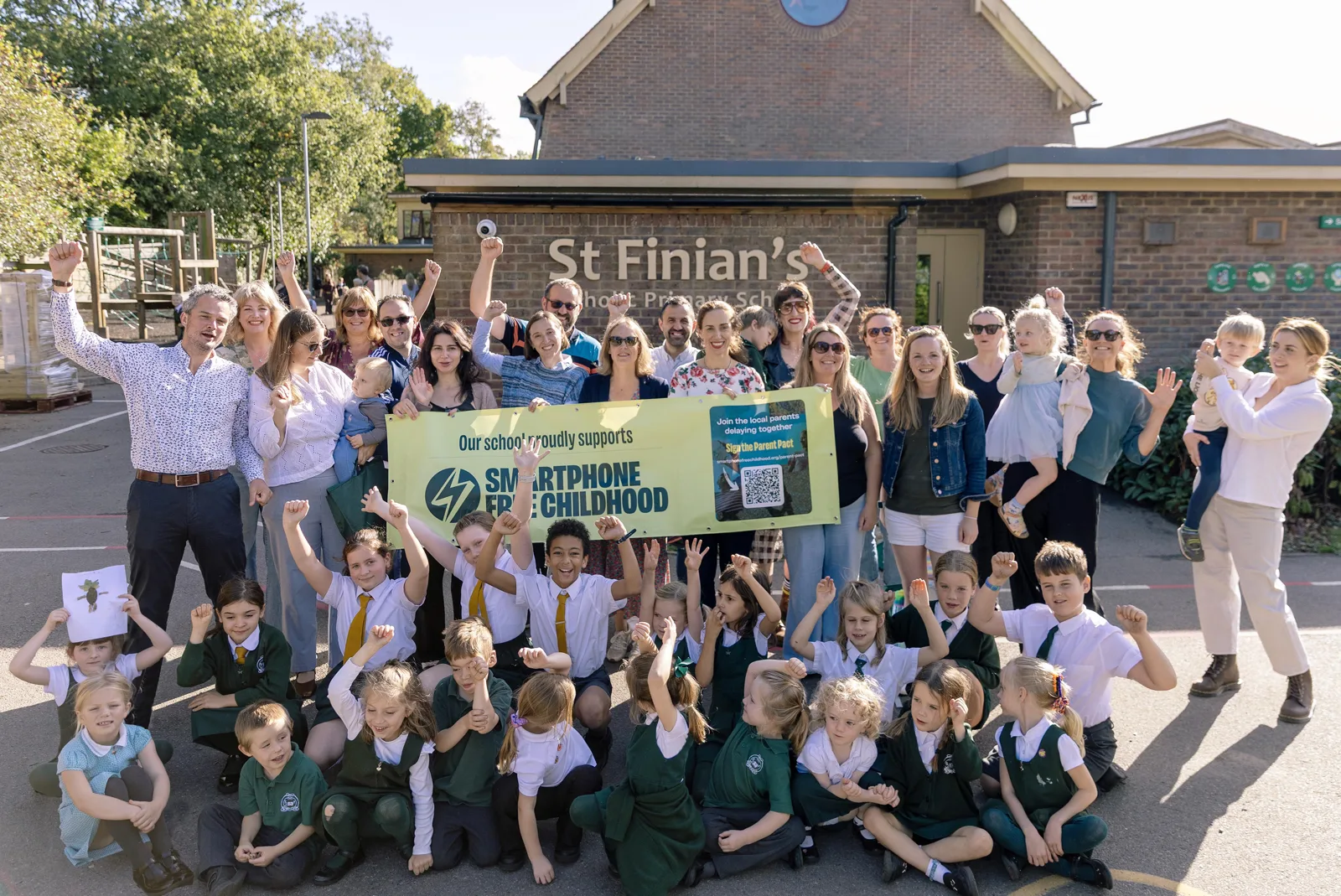

581 West Berkshire parents at 73 schools have signed a pact to delay smartphones until 14. Cold Ash's St Finian's head explains how her school backs it.
581 parents across 73 West Berkshire schools have now signed a pledge to hold off giving their children a smartphone until they are at least 14. The figures come from Angela Goulden, the regional leader for Smartphone Free Childhood West Berkshire, who sent them to The Newbury Times this week.
The pledge is the Smartphone Free Childhood Parent Pact. Families agree to delay a smartphone until 14 and social media until 16. They can see how many other parents in their child’s class and school have signed, so no child has to be the only one without.
St Finian’s Catholic Primary School in Cold Ash, about four miles north-east of Newbury, is the district’s leading school. The campaign’s press release in September put it at 53 parents, or 27% of families.
A survey this week took one school to 29%
The newest jump came this week at Englefield C of E Primary School, near Theale, about ten miles east of Newbury. Ms Goulden said the school ran a smartphone survey for parents this week. As a result, she said, 29% of its parents have now signed the pact.
Across the whole of Berkshire, the campaign’s September release counted 4,670 parents at more than 300 schools. Nationally, the campaign says 203,640 parents have now signed since the pact launched in September 2024.
How it started in West Berkshire
Ms Goulden is a parent of a young child. She told us she set out to raise awareness of the pact at her daughter’s school.
“We ran a simple Parent Smartphone Survey in February 2026 to gather views and it was very clear from the results that this is an issue a lot of parents are worried about,” she said. “This gave me the confidence to go further afield and support parents in other primary schools in West Berkshire to do the same.”
She is not against technology. “I don’t see tech as the enemy, it’s how we use it that matters,” she said. “I want my child and her peers to grow up confident using technology, not dependent on it.”
What signing means for a Year 5 or 6 family
Most children get their first smartphone when they move up to secondary school. Ms Goulden said signing lets parents in the same class agree to wait together, so a child knows they will not be alone at the step up.
Many families who delay give their child a “brick”, a simple phone that calls and texts, instead. That way, she said, parents can still keep in touch on the journey to and from school.
The hardest part, according to parents she knows who have done this, is the worry that their child will be the odd one out. “Parents definitely feel more confident when they know other parents are doing the same,” she said.
What the head teacher at St Finian’s says
St Finian’s families started signing in February 2026. We sent the school written questions through the campaign, and its headteacher, Mrs Jarratt, answered them.
She said staff have noticed “a growing awareness among families of the importance of healthy digital habits”, and more discussion of online safety, screen time and age-appropriate devices.
The school supports families through:
- advice on online safety and screen time in its newsletters
- online safety sessions for parents
- signposting to Smartphone Free Childhood, the NSPCC, CEOP and Internet Matters
- digital citizenship lessons in its personal development curriculum, “Life to the Full”, and its oracy curriculum
- parent meetings at the school, where families can share experiences
- Year 6 workshops on digital safety run by community safety officers
Pupils at St Finian’s are not allowed to use mobile phones during the school day. The few phones brought in for safety are handed to the office and stored until home time.
Asked what she would say to a parent worried their child will be left out, Mrs Jarratt said: “We are promoting and encouraging a group response and commitment, thereby alleviating these worries as more and more people are on board. Parents are also becoming more assured of their own stance and decisions on this.”
The new study on smartphones and children’s mental health
The campaign points to new research by Gregory Veramendi, an associate professor of economics at Royal Holloway, University of London. The Institute for Fiscal Studies published it as a working paper on 23 July 2026. (IFS, Smartphones and children’s mental health)
He compared 329 primary schools in England where at least a fifth of families had signed with matched schools where under 5% had. The matching used each school’s earlier mental health needs, deprivation, free school meal share and size.
His main findings:
- recorded social, emotional and mental health (SEMH) need fell by 8.2% against the matched schools where at least one in five families signed
- the fall was about 3% where around one in ten families signed
- child psychiatric Disability Living Allowance claims near those schools fell by about 6%
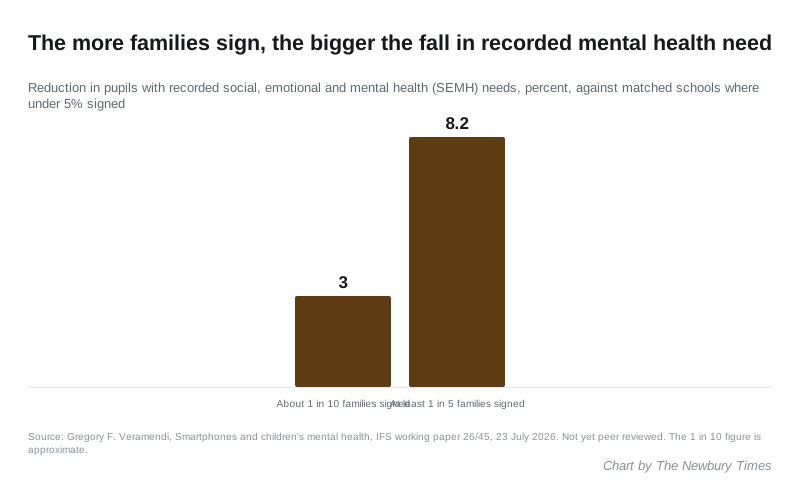
There are limits. IFS working papers have not been through external peer review, and this one is no exception. The schools with high sign-up were, on average, more affluent than the rest, which is why the author matched them with similar schools. The paper also measures sign-up as of June 2026, after some of the outcomes were recorded. The author says this probably makes his estimates conservative. (IFS working paper 26/45, PDF)
The campaign says it did not fund or design the study.
What it means for you
- To see how many families at your child’s school have signed, look the school up on the Parent Pact. Signing is free.
- To talk to other local parents, join the Smartphone Free Childhood West Berkshire WhatsApp group.
- A talk for parents, teachers and head teachers in West Berkshire is being organised. Ms Goulden said details will be released soon. We will add them here when they are.
- For term dates and the school year ahead, see our West Berkshire school term dates.
Have your say